

Photo by Bettmann Archive/Getty Images
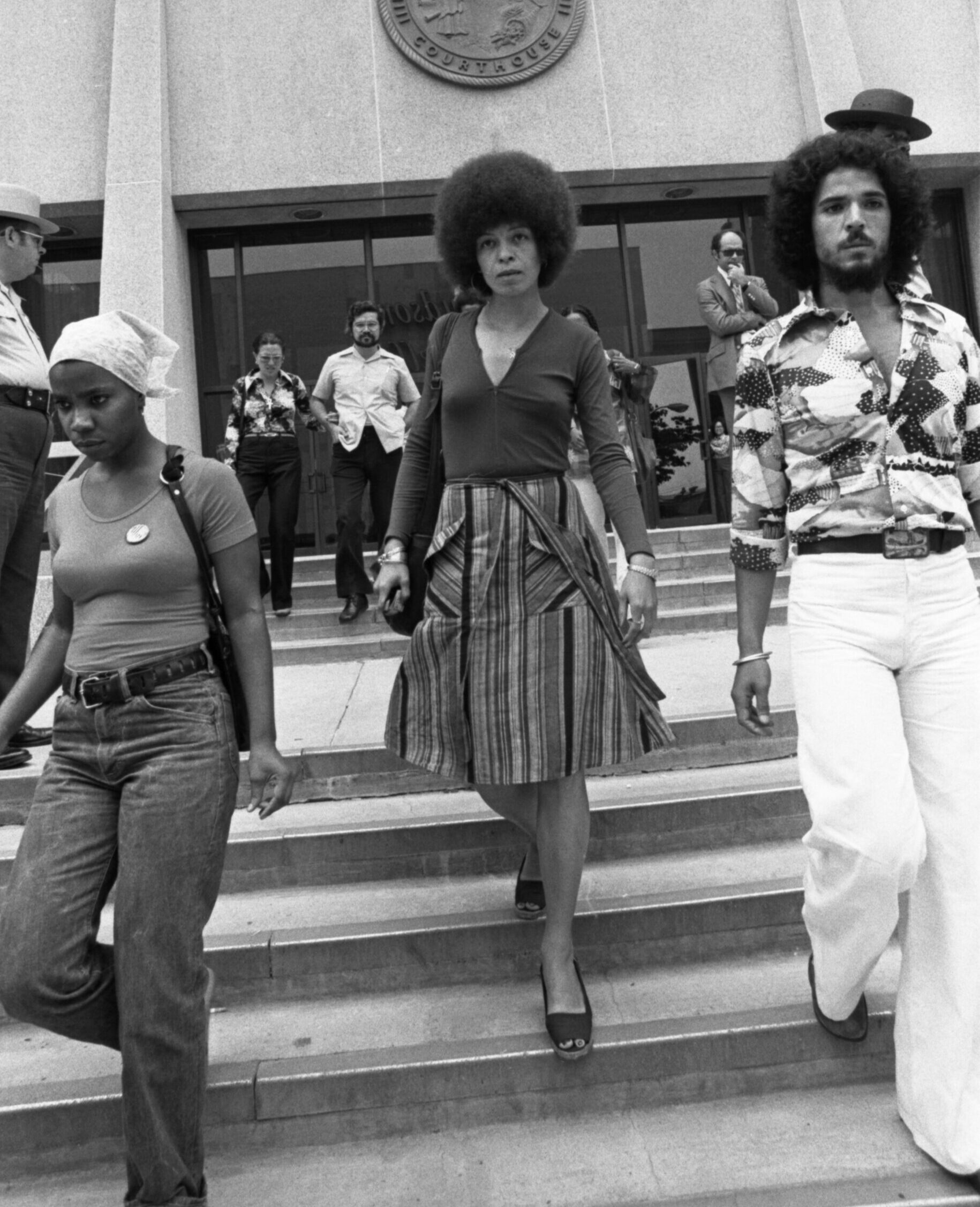
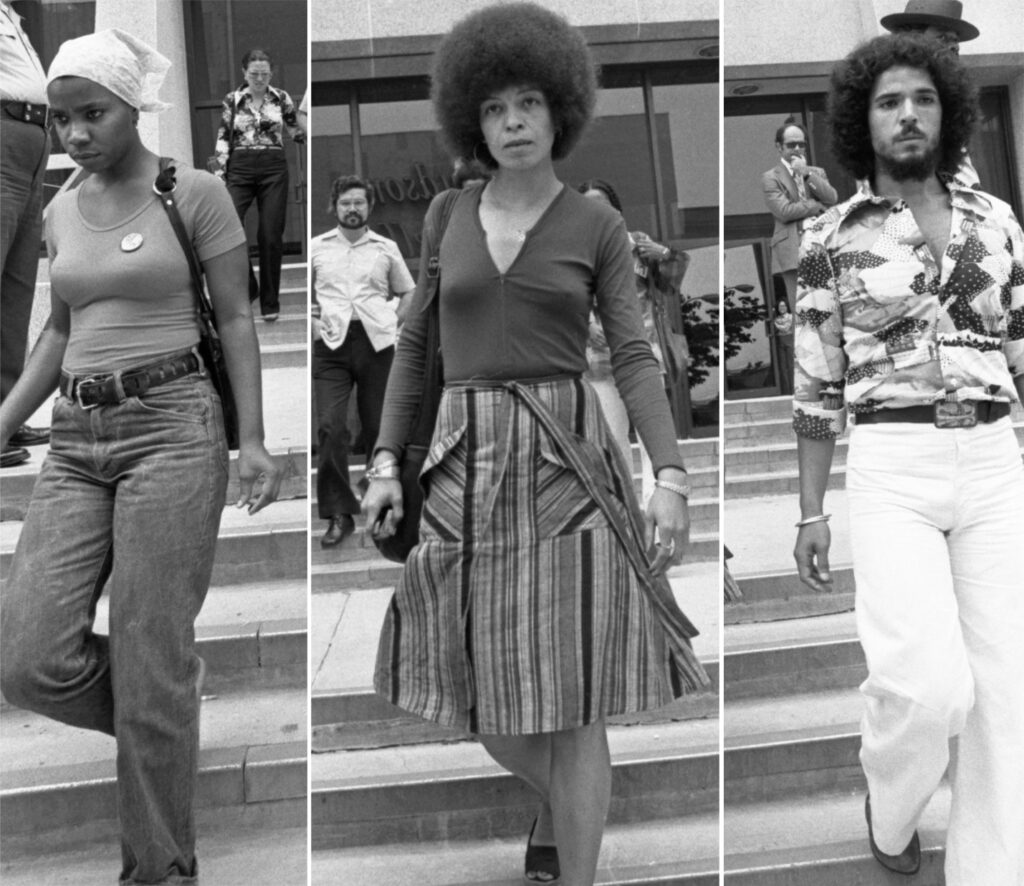
The image above captures a moment in the movement for the rights of women to defend themselves from sexual assault. Three people descend the steps, with a purposeful manner, a serious stride, showing how marginalized people can fight against systems that have historically discriminated against them.
Absent from the photograph are the legal proceedings that led up to this critical moment—the charges on August 27, 1974, against 22-year-old Joan Little for the killing of Clarence Alligood, a 62-year-old white prison guard at Beaufort County jail in Washington, North Carolina.
Alligood had attempted to rape Little before she defended herself, and he sustained stab wounds to the temple and heart area from an icepick. Little turned herself in to the police after a week.
In the image, we cannot see the crowd beyond a few people: Angela Davis herself, journalists, supporters, and opponents of Little, who had been watching the case take place. Little’s charges became a poster for the Black power and Black freedom movement.
The image resonates with current-day sensibilities. Contemporary activists similarly use public spaces and symbols of defiance to challenge authority.
Several elements of the photograph stand out.
First, the confidence of Davis and the others radiates through their posture, their unblinking eyes focusing on what is in front of them. Davis and other celebrities were attracted to the case because it became a national cause for prisoners’ rights, feminists, and people advocating against the death penalty and for racial justice.
Davis was a firm supporter of Little’s case as she covered the trial for Ms. Magazine, highlighting how it was an important intersection of race, gender, and anti-rape activism. The article she published was titled, “Joanne Little: The Dialectics of Rape,” with the magazine misspelling her name as early reports did.
The photograph was taken during an intense political time in the United States. Courtrooms had become new battlegrounds over civil liberties, racial equality, and women’s rights. As Davis and the others left together in solidarity, symbolizing unity and support for Little and her rights, their confidence epitomized the fight for women’s civil rights.
Their image reminds us that social change happens in everyday moments made significant through courageous actions. The photograph teaches us that both protest and participation can happen in multiple ways.
It also proves how important representation is, as embodied by activists like Davis outside a civic arena, continuing to fight for the rights of others, and particularly for black women in prison. Davis wrote in her 1975 piece for Ms. Magazine, “The only force powerful enough to reverse the normal, repressive course of events is the might of great numbers of people.”
Little was eventually acquitted of murder in August 1975. Six white and six black jurors deliberated for an hour and 25 minutes. She was the first woman in the United States to be acquitted of murder on the grounds of the use of deadly force to resist sexual assault.

Photo by Bettmann Archive/Getty Images
Little, who is pictured above, made her last public appearance in 1989. She has since disappeared from public view.
October 26, 2026

Learn more:
Davis, Angela. Angela Davis: An Autobiography. New York City: Random House, 1974.
Greene, Christina. Free Joan Little: The Politices of Race, Sexual Violence, and Imprisonment. Chapel Hill, North Carolina: University of North Carolina Press, 2022.
Davis, Angela. “Joan Little and the Dialetics of Rape.” Ms. Magazine, June 1975, https://msmagazine.com/2024/03/05/joan-little-dialectics-of-rape-june-1975/.