

Photo by Heritage Images/Getty Images
In 1898, NC Mutual Life Insurance Company opened to provide for “the relief of the distress of Negroes.” While its original purpose was to ensure dignified burials, it quickly evolved into a financial and social giant that undergirded the Black communities in Durham, North Carolina and across the United States during the early 20th century.
Situated in the heart of downtown Durham, NC Mutual survived Jim Crow, white flight, integration, every major financial and social episode since its inception, and the construction of the Durham Freeway in the 1970s.
After a steady decline in their customer base as Blacks gained access to more resources following integration, however, NC Mutual could no longer absorb the burden of other failing Black owned insurance companies and was declared insolvent in 2022. Only its headquarters remain as a reminder of African Americans’ efforts to build an independent community following Reconstruction.
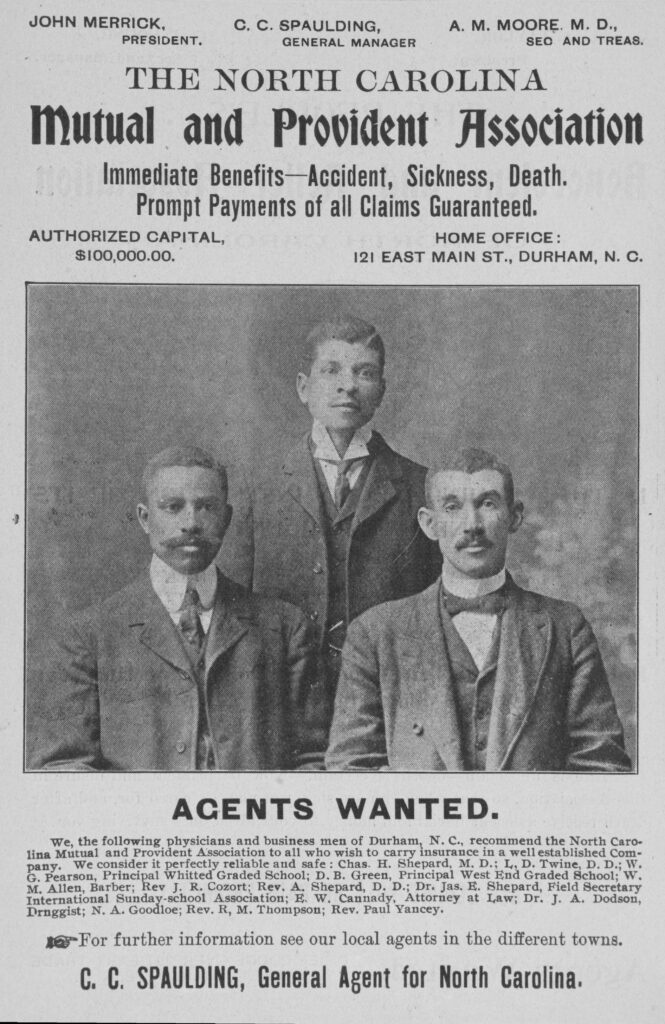
Photo by Heritage Images/Getty Images
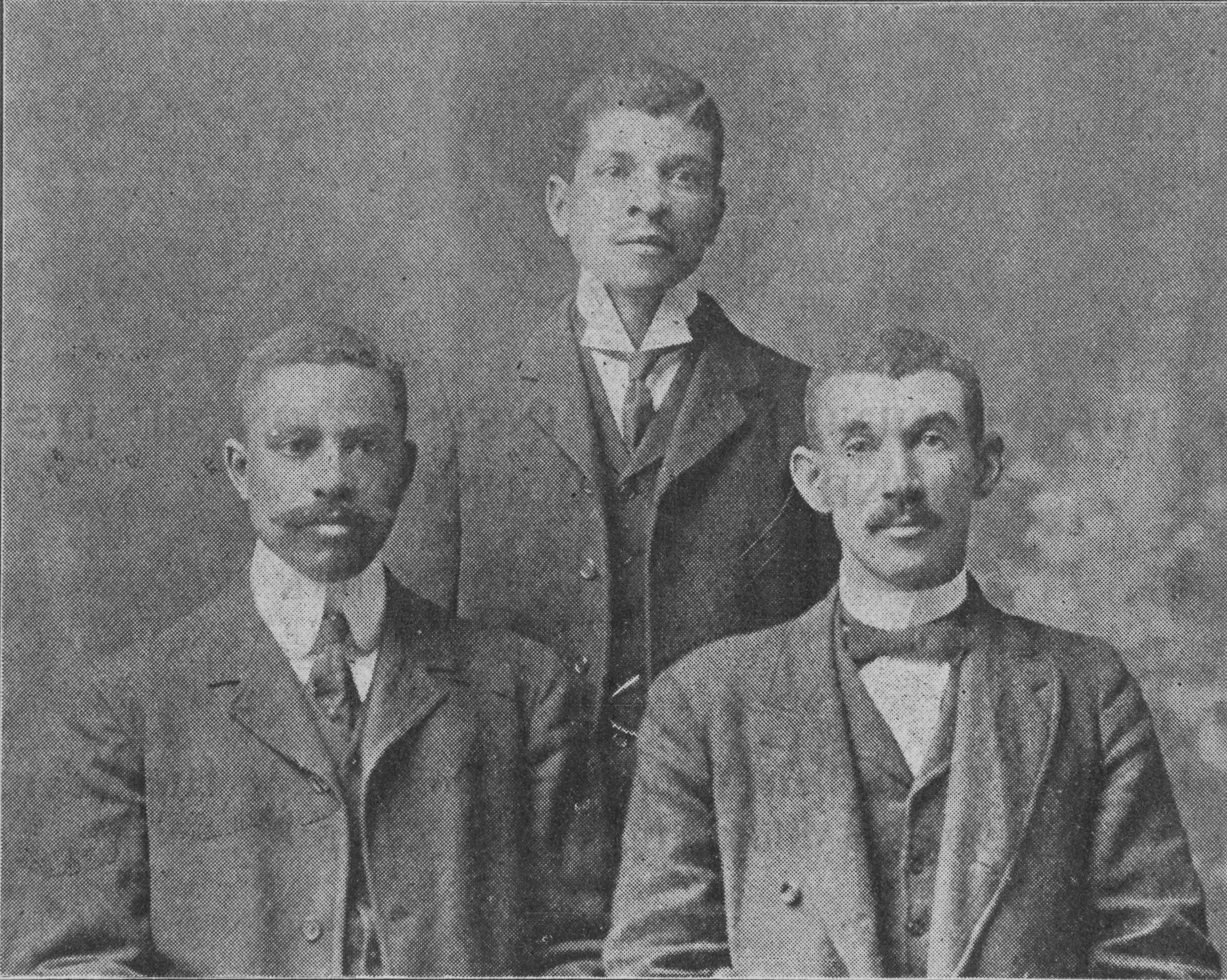
Organized by eight prominent African American men of Durham, the company eventually became closely associated with three: John Merrick, Dr. Aaron Moore, and Charles Clinton Spaulding, its first manager. All three men can be seen above in a 1903 advertisement for the company.
Opening only a few weeks before the 1898 Wilmington Massacre, in which a thriving Black community was destroyed by white supremacist violence, NC Mutual became a symbol of hope and resilience. Its founders understood the value of Black labor, which had long supported the prosperity of white society.
NC Mutual embraced a philosophy of shared prosperity based on African aid societies of the late 18th and early 19th centuries. Merrick was a founding member of the Royal Knights of King David of Durham, a fraternal order with “feed the hungry, succor the fatherless and widows” as part of its motto.
Just as the Royal Knights worked to ensure African Americans had access to jobs and resources, NC Mutual provided financial backing for African American businesses and entrepreneurs, offering resources and services white-owned banks refused to offer. With the help of NC Mutual and its affiliates, African Americans had access to jobs outside of manual labor as well as opportunities to build businesses and create communities of their own.
Merrick, Moore, and Spaulding founded and supported numerous businesses, hospitals, schools and societies in and around Durham. Often, they relied on the financial support of tobacco merchant Washington Duke, a friend of Merrick who was once his personal barber, and the Duke family.
While NC Mutual ventures addressed the exclusion of African Americans, they did not deny white citizens services. Lincoln Hospital for Negroes, founded by Moore, saw patients regardless of race or ability to pay.
The influence of the three major founders was instrumental to the success and political sway of the company in and outside of North Carolina, with Spaulding serving as race relations advisor to President Franklin Roosevelt and as chairman of the Urban League’s Emergency Advisory Council.
The photo below by Charles “Teenie” Harris captures company employees in March 1945, posing outside of the office at 2018 Centre Avenue, Hill District, Pittsburgh, Pennsylvania.

Photo by Charles “Teenie” Harris/Getty Images
By the time its imposing tower was built in 1966, all the original founders and major contributors were long deceased, and downtown Durham was on the cusp of major changes.
The construction of the Durham Freeway meant the demolition of much of the historic Black neighborhood, including the home of Dr. Moore and the church where he opened the Colored Library of Durham. Subsequently, the community fractured as access to schools, housing, and resources, previously denied under segregation, became available to African Americans.
It is ironic that rather than equalizing society, integration often meant Black businesses, schools, and neighborhoods were deserted, leaving only the very poor behind. In the latter part of the 20th century, NC Mutual struggled to remain relevant while white insurance companies grew and Black companies declined.
More recently, as businesses and whites returned to downtown Durham, NC Mutual’s building, but not the company within, became a major part of revitalization schemes. These schemes did not include African Americans nor the poor of any race whose patronage had maintained the company for more than a century.
That NC Mutual survived and thrived for so long when other Black insurance companies failed and the community surrounding it had been divided and demolished, may be attributed to its strong foundation and early commitment to protecting the labor of African Americans even as they were excluded from the mainstream.
Its significance as an institution devoted to protecting the labor of and providing resources to minorities and the poor has also been neglected.
May 6, 2026

Learn more:
Walter B. Weare, Black Business in the New South: The Social History of the NC Mutual Life Insurance Company (Durham, Duke University Press, 1993).
Leslie Brown, Upbuilding Black Durham: Gender, Class, and Community Development in the Jim Crow South (Chapel Hill, The University of North Carolina Press, 2008).
W.E.B. DuBois, “The Upbuilding of Black Durham: The Success of the Negroes and Their Value to a Tolerant and Helpful Southern City,” World’s Work, vol. 23, January 1912.