

Photo by Bettmann Archive/Getty Images
In the late 19th and early 20th centuries, Black Americans’ efforts toward racial uplift and progress came through top-down methods carried out by highly visible race men, women, and organizations. In this period, the “politics of respectability,” a strategy that relied on individual behavior and morality, worked in tandem with the push for Black representation in politics, sports, and media.
Historically, race leaders often believed respectable representations of the race would garner white support for political equality. This focus on representation was not exclusive to Black race leaders, as over time, white politicians also realized the importance of appealing to the Black electorate through representation.
Throughout the Black freedom struggle, the effort toward racial uplift through race solidarity, representation, and the politics of respectability has masked the harm that some people, groups, and ideologies have done to Black women. Clarence Thomas’ confirmation hearings in 1991 are an example of how the need for representation took precedence over the treatment of Black women.
President George H.W. Bush nominated Thomas (in the photograph below) to replace Thurgood Marshall following his retirement in 1991. Thomas had only a year of experience as a judge, but he was a darling of some conservatives for his views on affirmative action and civil rights and the natural law foundations of his legal philosophy.
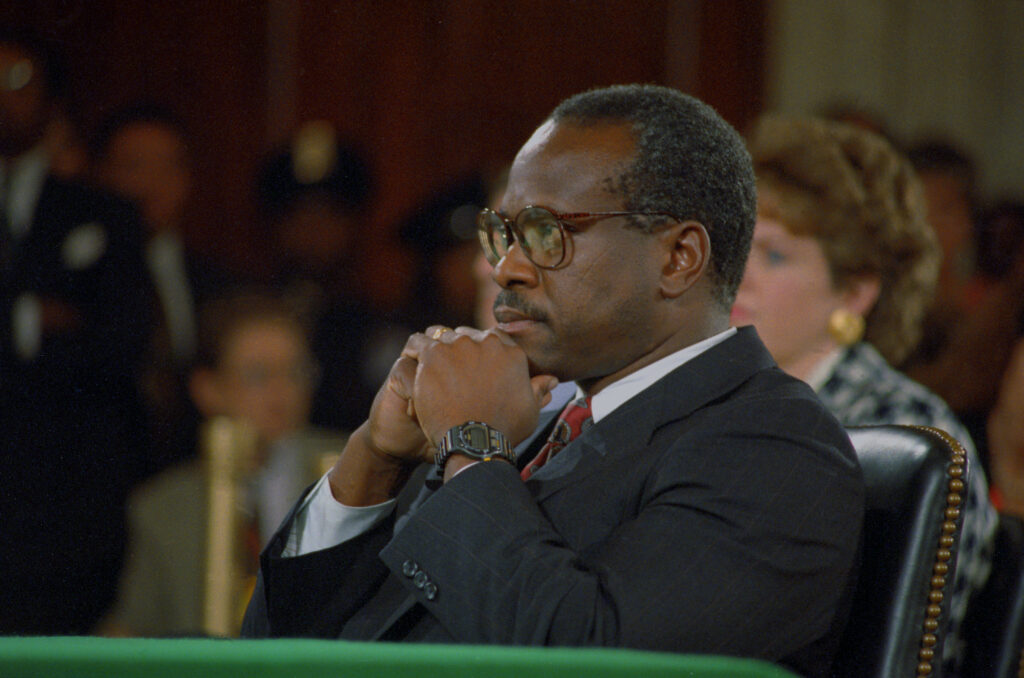
Photo by Bettmann Archive/Getty Images
During the judiciary committee’s confirmation investigation, Anita Hill (photographed at the hearings below), a former co-worker of Thomas, claimed he sexually harassed her when he was her supervisor at the Equal Employment Opportunity Commission.
The otherwise uneventful hearings then became a sensation. Thomas responded to the investigation, claiming he was being subjected to a “high-tech lynching for uppity Blacks,” rendering Hill as the accuser, the Senate a mob, and himself the victim.
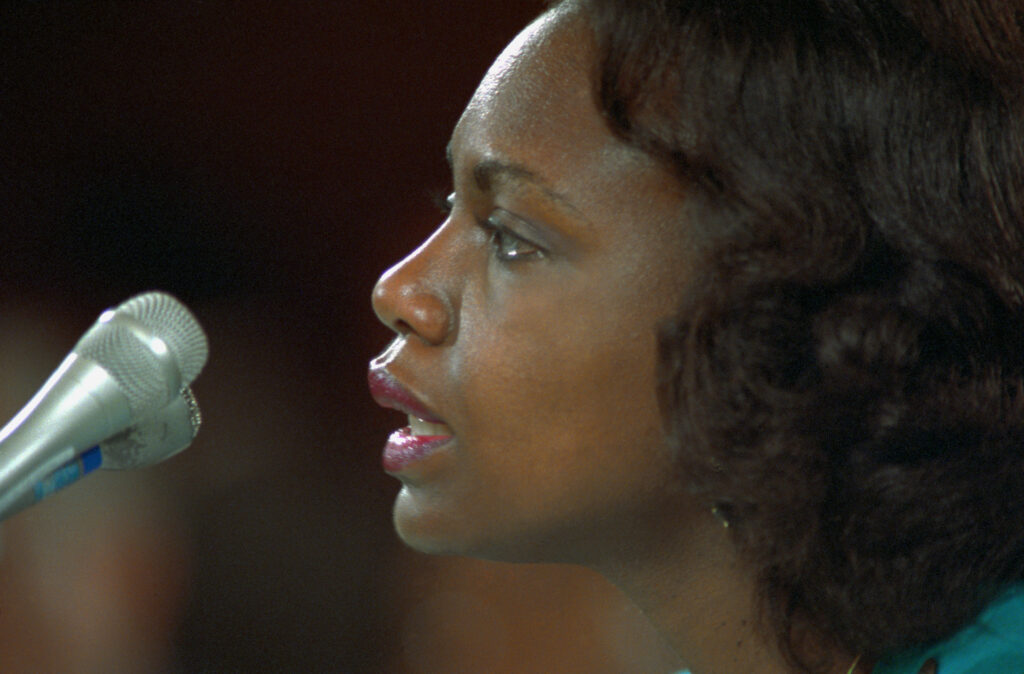
Photo by Bettmann Archive/Getty Images
In essence, Thomas used the history of lynching—a mode of violence that people associate almost entirely with Black men—against a Black woman.
The hearings split the Black community. Some believed Hill and saw Thomas as unfit for the nation’s highest court. Others saw Hill as betraying the race by turning on a Black man.
Harvard professor Orlando Patterson, one of Thomas’ most prominent supporters, said that under the circumstances, “Judge Thomas was justified in denying making the remarks, even if he had, in fact, made them …”
On the other hand, Judge Leon Higginbotham, next to Marshall the senior Black jurist in the country and a staunch opponent of Thomas’ elevation to the Supreme Court, was certain that if Anita Hill had been white, she would have been taken more seriously. “There’s still within our legal culture,” he said, “a preception that black women can be treated different and more adversely than anyone else.”
The Senate wound up confirming Thomas 52-48, one of the closest confirmation votes in American history.
Thomas’s case is just one example of a false binary between support for racial uplift and supporting victims of sexual harassment by framing that support as an unscrupulous effort to stifle Black men’s upward social mobility.
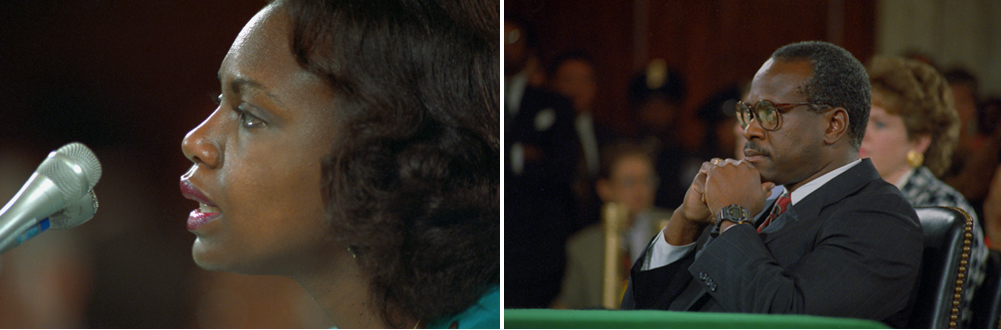
Photo by Bettmann Archive/Getty Images
Photo by Bettmann Archive/Getty Images
Additionally, the tension between feminism and Black racial uplift created a rift about who can represent the race, what advancement is, and how or if one’s behavior tarnishes their impact on racial uplift.
For some Black Americans, Thomas’s conservative political views placed him outside of race solidarity much more than his sexual harassment and demonization of a Black woman did.
The purpose of this essay is not to tell readers which side to be on, but to encourage people to dissect the complexities of racial uplift. Not only should a person’s politics determine their role in the Black freedom struggle, but also their treatment of other people they are supposedly representing or advocating for. Black women’s struggles and Black feminist ideology not only align with but aid the Black freedom struggle and cannot be ostracized or separated from it.
June 8, 2026

Learn more:
Carby, Hazel V. Race Men. 1st ed. The W. E. B. Du Bois Lectures. Harvard University Press,
1998. https://doi.org/10.4159/9780674262515.
Drake, St Clair. Black Metropolis; a Study of Negro Life in a Northern City. Rev. and enl. Ed.
With Horace R. Cayton. A Harbinger Book, H 078-H 079. Harcourt, Brace & World, 1970.
Smitherman, Geneva. African American Women Speak out on Anita Hill-Clarence Thomas.
African American Life Series. Wayne State University Press, 1995.