

Photo by Bettmann Archive/Getty Images
Minutes after midnight on May 14, 1970, and into the early hours of May 15, Mississippi Highway Patrol officers fired more than 400 rounds of ammunition into Alexander Hall, the women’s dormitory at Jackson State College.
Four hundred rounds of ammunition fired in every direction over the span of a mere 28 seconds resulted in the murders of Phillip Lafayette Gibbs and James Earl Green and the wounding of twelve others. The photo above captures the bullet-riddled glass of a window at the dormitory.
Gibbs was a junior political science major at Jackson State. Green, a senior at Jim Hill High School, was heading home from his after-school job located on the street opposite Alexander Hall.
By 1970, college students across the nation were protesting the United States’s increasing role in the Vietnam War. Barely two weeks before the tragedy at Jackson State, members of the Ohio National Guard opened fire on students at Kent State University in response to their ongoing anti-war demonstrations. This resulted in four students killed and nine others severely wounded.
In the days following the violence against students in Ohio, Jackson State students met a similar fate.
Jackson State’s students shared the antiwar sentiments of many students at the time, and they actively participated in the continued struggle for civil rights. But the shootings on campus were not a response to any demonstration.
Earlier on May 14, 1970, there were reports that a dump truck had been set on fire in the middle of John R. Lynch Street. Later, this report was used to justify a police attack against the students, despite the absence of any evidence that the fire was set by any student activists. Still, with reports of vandalism, white authorities marched onto campus with military-grade weaponry and the intent to use force against the students.
Survivors like Vernon Steve Weakley recounted that it was a typical evening. The male students were hanging out in front of the women’s dormitory as they often did. Students like Phillip Gibbs and a young James Earl Green were thinking about and preparing for their futures. As students conversed and thought about their upcoming commencement, they felt a shift in the atmosphere.
Jackson State students at Alexander watched highway patrolmen pass by and then return. Survivors noted that they felt tensions rising as the armed officers approached them.
As the officers instructed students to enter the dormitory for no reason, a bottle was thrown from behind the officers. The bottle landed in front of the officers, which caused them to begin firing on the students. The unarmed, Black students scrambled to escape the gunfire and to avoid the broken glass from the dormitory windows being shot. As they fled, students were shot with their backs and heads turned away from the Highway Patrol.
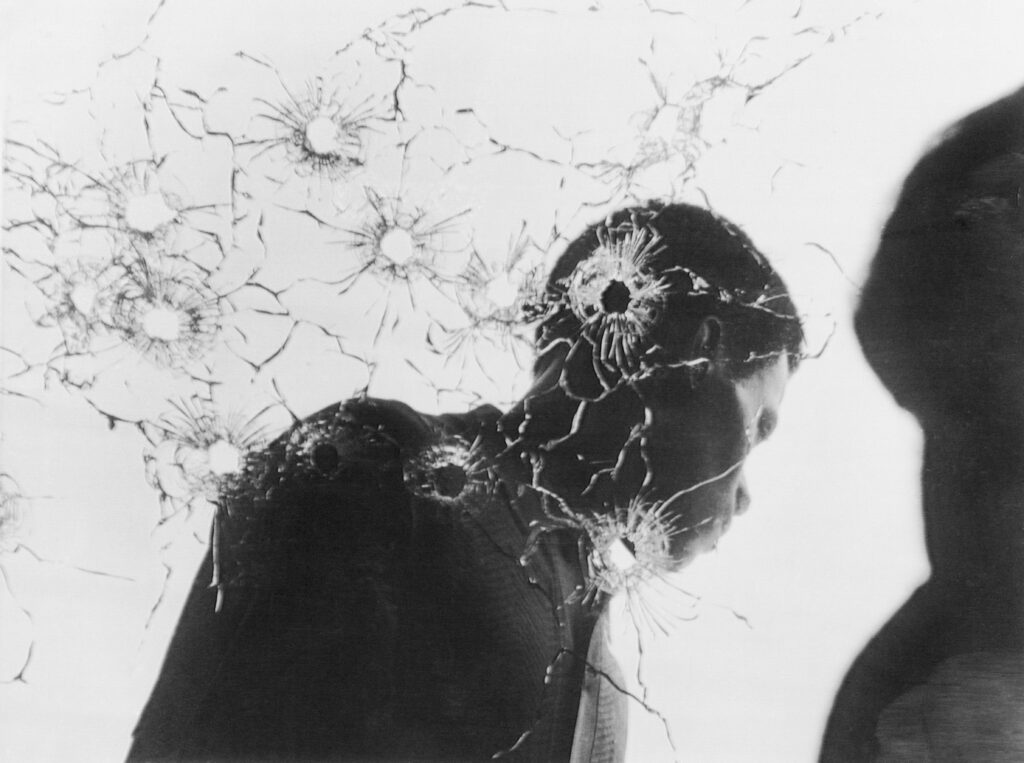
Photo by Bettmann Archive/Getty Images
The image above depicts a young man facing away from the bullet-riddled glass after the attack. The composition of the photo makes us see him as a potential victim of the indiscriminate shooting. It creates an immediacy for the viewer, as if we are present at the moment of horror.
Although this first image reflects the vulnerability of the Black youth, the photo below highlights their resilience, power, and pride. In front of a shattered window, the students exude courage and become symbols of strength in community as they stand tall together.
The image also captures a moment of remembrance as students gathered on May 15 to mourn the tragedy.
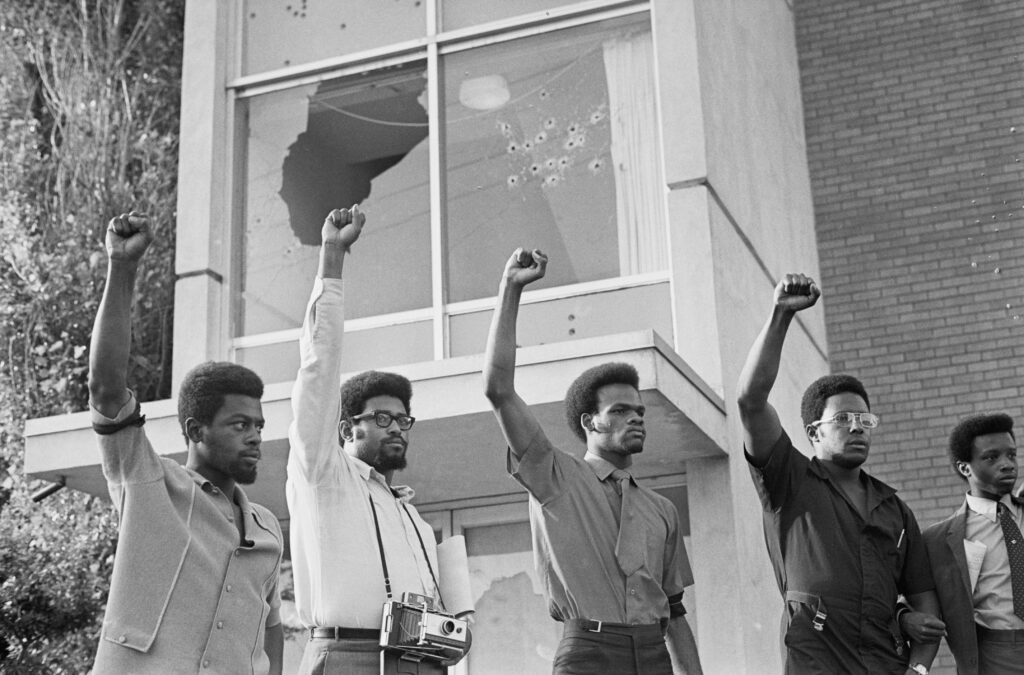
Photo by Bettmann Archive/Getty Images
In the aftermath of this attack on the Black students, state officials alleged that they’d received reports of snipers being at the women’s dormitory. There is now evidence of snipers and the shooting of James Green, which occurred in the opposite direction of the alleged snipers, helps confirm that falsehood.
While anti-war demonstrations and protests for civil rights were happening across the nation, this tragedy was not the first time that white supremacist violence would occur on college campuses in the state or nation. Nor would it be the last. Despite the anti-Black violence that continues to happen under the cover of darkness and under masks, Black youth continue to stand tall and together in their fight for justice and equality for all people.
May 27, 2026

Learn more:
Bristow, Nancy K. Steeped in the Blood of Racism: Black Power, Law and Order, and the 1970
Shootings at Jackson State College. Oxford University Press, 2020.
Spofford, Tim. Lynch Street: The May 1970 Slayings at Jackson State. Kent State Univ Press, 1988.
Weakley, Vernon Steve. Standing at the Edge of Madness. Zworld-net Publishing, Inc.,1999.