

Photo by Hulton Archive/Getty Images
When W. Arthur Lewis was awarded the Nobel Memorial Prize in Economic Sciences in 1979, the world acknowledged his contributions to the field of development economics. Lewis helped establish Ghana’s economic foundation as an independent nation and served the Caribbean Development Bank as its first president from 1970 to 1973.
To date, Lewis remains the only Black economist to win the Nobel Prize, and he was the first Black person in any discipline promoted to full professor at Princeton University.
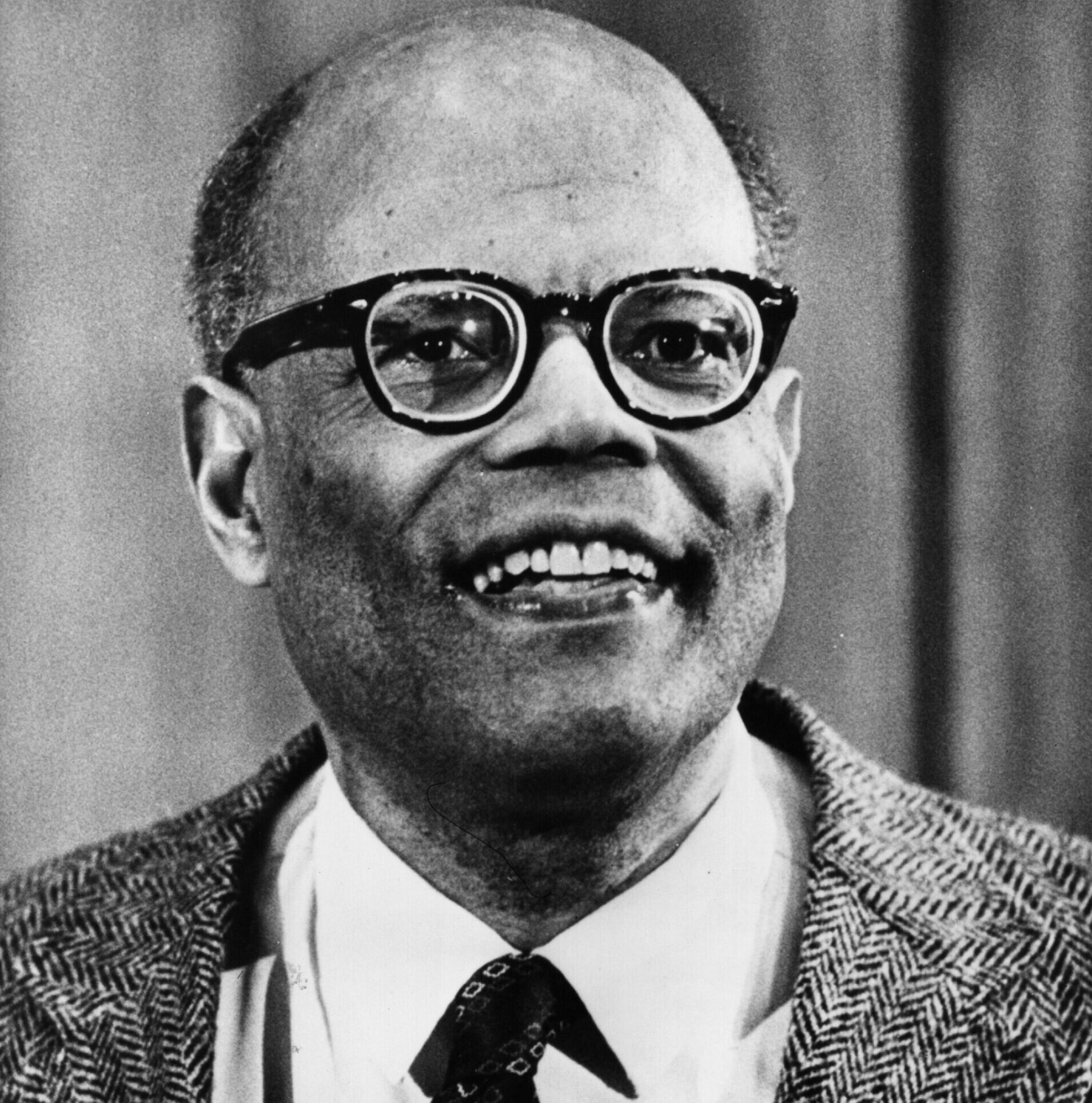
Lewis (photographed above, from 1979) was born on January 23, 1915, in St. Lucia, then still a British colony. A child of schoolteachers, he spent his early years in a household that prioritized education.
In 1933, Lewis enrolled at the London School of Economics (LSE). In his classes, he stood out as a student and future scholar. His success in his studies positioned him favorably within the university.
Throughout Lewis’ time at LSE, he was surrounded by pioneering thinkers in economics, including Friedrich Hayek and Arnold Plant, his PhD supervisor. Lewis graduated from LSE with first class honors in 1937, and it was on Plant’s recommendation that Lewis later enrolled in the PhD program in economics.
While in Britain, Lewis was also involved with the League of Colored Peoples (LCP), led by Harold Moody. The LCP had several aims, all directed toward creating equality and improving the wellbeing of Black people worldwide.
This intellectual space contributed deeply to Lewis’ pan-African mindset. After completing his PhD in 1940, Lewis began his scholarly career as an assistant professor at LSE. He began teaching at the University of Manchester in 1948.
In 1952, Lewis received an invitation from the Convention People’s Party, led by Kwame Nkrumah, to advise the government of the Gold Coast (present day Ghana) on industrialization. His research report, “Industrialization and the Gold Coast,” provided economic analysis and policy recommendations that helped shape further initiatives by the Ghanaian government.
Lewis went on to consult with leaders on other economic matters, including the Volta River project, the 10-year plan, and the budget. In addition to the work he did for the Gold Coast, Lewis also worked as a consultant for the government of Nigeria in 1955 to advise on industrialization.
On March 6, 1957, the Gold Coast gained independence from Britain, and the independent nation of Ghana was born. The move to independence was the first of its kind in sub-Saharan Africa, and intellectuals such as W.E.B. DuBois, C.L.R. James, and George Padmore traveled to Accra to celebrate.
That same year, through a two-year United Nations contract, Lewis went on to serve as the chief economic advisor to Nkrumah. During that time, he authored two research reports: “Politics in West Africa” and “Some Aspects of Economic Development.”
Lewis left this position in 1958 due to disagreements with Nkrumah and intense public scrutiny. With his departure, Lewis did not totally cut ties to Ghana, and he returned in 1963 to aid on the Seven-Year Development Plan.
From 1959 to 1963, Lewis worked as Principal of the University College of the West Indies. In this role, he raised money, increased student engagement, and expanded academic programming. His work to uplift the university contributed to the development and matriculation of countless students who looked to him for mentorship and inspiration.
In 1963, Lewis took a professorship at Princeton, becoming the first person of Black descent to attain that role. After seven years, Lewis received an offer from leaders in the West Indies to head the newly created Caribbean Development Bank.
During his tenure with the Caribbean Development Bank from 1970 to 1973, he fostered integration within the region, promoted economic growth and finance development projects, and oversaw the strategic foundation of the institution.

Photo by Bettmann Archive/Getty Images
In 1979, Lewis was awarded the Nobel Memorial Prize in Economic Sciences. He shared the prize with Theodore Schultz. The picture above shows Dr. W. Arthur Lewis standing second from the right, next to co-winner Theodore W. Schultz on the far right.
Administrative faculty at Princeton’s Woodrow Wilson School, including the dean, John P. Lewis, supported Lewis’ nomination for the award. The Nobel Prize committee identified several of his published papers as significant, including his 1954 publication “Economic Development with Unlimited Supplies of Labor.” This paper cemented the field of development economics and introduced his famous “dual sector” model of development.
W. Arthur Lewis died on June 15, 1991. He left behind immense contributions to the field of development economics and social science, which were important to the growth of political selfhood within the Caribbean and Africa.
October 30, 2026

Learn more:
A. Lewis, “Biographical Note,” Social and Economic Studies 29(4): 1980.
A.E. Stone Roofe, “Arthur Lewis: Nobel Actor on a Pan-African Stage,” in Adebajo A, ed., The Pan-African Pantheon: Prophets, Poets, and Philosophers (Manchester University Press, 2021), 311-323.
R. L. Tignor, W. Arthur Lewis and the Birth of Development Economics (Princeton University Press, 2020).