Photo by Bettmann Archive/Getty Images
Throughout the 1950s and 1960s, Black college students, with the help of Civil Rights organizations, sought to integrate American universities and end racial discrimination within higher education.
In 1962, Vivian Malone and James Hood submitted their applications to the University of Alabama, beginning a several month process to end racial segregation in higher education across the state and integrate the University of Alabama.
Their efforts to challenge segregation exposed the political and legal conflicts between state and federal governments, a struggle captured in this photograph of Malone and Hood outside of Foster Auditorium.
This moment, widely circulated in newspapers and television broadcasts, symbolized competing visions of America: those committed to maintaining racial segregation and Malone and Hood’s determination on equal access to education.
James Hood was born on November 10, 1942, in East Gadsden, Alabama. He attended Carver High School, a majority Black school in his neighborhood, where he excelled as an athlete and was elected student body president. Hood attended Clark College, a Black college in Atlanta, but he ultimately decided to transfer to the University of Alabama because Clark did not have a clinical psychology program.
Vivian Malone was born on July 15, 1942, in Mobile, Alabama. She attended Central High School, a nearby segregated school for Black students. After high school, Malone enrolled at the Alabama Agricultural and Mechanical College (AAMC), a Black college in Huntsville, Alabama.
At AAMC Malone pursued a degree in business education and was a member of Delta Sigma Theta Sorority. Although she was well accustomed to campus life there, Malone had plans of working in personnel management, and the necessary courses to thrive in that profession were only offered at the University of Alabama.
The efforts of Malone and Hood to integrate the University of Alabama were challenged by Governor George Wallace. Wallace, a pro-segregationist, built his bid for governor on maintaining the state’s rigid racial hierarchy. During his 1963 inaugural address delivered in Montgomery, Wallace declared “segregation now, segregation tomorrow, and segregation forever.”
As the photograph suggests, Wallace’s defiance opened a battleground between state sovereignty and federal authority.
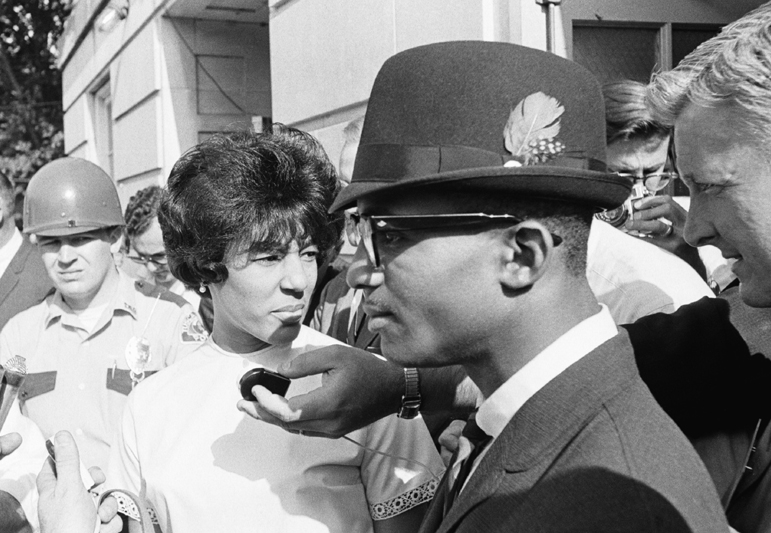
Photo by Bettmann Archive/Getty Images
To halt Malone and Hood from registering for summer courses on June 11, 1963, Wallace staged a “Stand in the Schoolhouse Door” campaign. In response, President John F. Kennedy issued Proclamation 3542 insisting that Wallace and others cease from prohibiting Malone and Hood from enrolling.
Wallace, believing that Kennedy’s proclamation had no power, refused to step aside. Kennedy shortly thereafter issued Executive Order 11111 mandating the Alabama National Guard to aid Malone and Hood to enter University of Alabama’s Foster Auditorium to register for classes.
The two successfully registered for courses.
James Hood ultimately left the University of Alabama in July 1963, after publishing a controversial article in the school’s newspaper the Crimson-White. In the article, he critiqued African Americans’ focus on protest for civil rights demonstrations like sit-ins and picketing, and instead advocated that “there must be more time spent in the classroom and less time wasted on picket lines.”
Shortly after his article was published in the school newspaper it was reprinted by newspapers across the state. Hood, ashamed that his writing left the walls of the university, regretted his word choice. He later returned home and dropped out from the University of Alabama.
Vivian Malone continued her studies at the University of Alabama, where she lived on-campus in the Mary Burke Hall during her first year. Police believed that a series of bombs going off near campus were prompted by Malone’s presence on-campus, but it was never confirmed.
She graduated in 1965 with a bachelor’s in industrial relations, making her the first African American to graduate from the university. Sarah Healy, the dean of women, shared that “Vivian Malone has proved to be a good student, a friend, and worthy alumnus.”
Despite these words, Vivian recalled that her time at the university was rather isolating. Still, she encouraged other African Americans who were interested in receiving a good education to enroll there.
Though Vivian Malone and James Hood received recognition for integrating the University of Alabama, Autherine Lucy had been the first person to attend the university in 1956. However, after three days of unrest on campus, she was expelled on the grounds that she made campus life unsafe for the student body. Vivian Malone and James Hood were at the center of a battle over who had the greatest jurisdiction in dictating race relations within this country.

Learn more:
E. Culpepper Clark, The Schoolhouse Door: Segregation’s Last Stand at the University of Alabama (New York & Oxford: Oxford University Press, 1993).
B.J. Hollars, Opening the Doors: The Desegregation of the University of Alabama and the Fight for Civil Rights in Tuscaloosa (Tuscaloosa: University of Alabama Press, 2013).