

Photo by Bettmann Archive/Getty Images
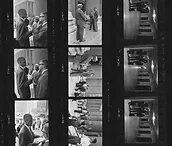
The image above depicts acclaimed U.S. American athlete, scientist, and businessman Edwin Moses in the run-up to 1976 Olympic games. A graduate of Morehouse College, the only all-male Historically Black College in the world and a site of Black Excellence, Moses’s scholarship and self-coaching were core tenets of his tremendous success in multiple domains.
The son of two educators (one of whom served as a Tuskegee Airman), Edwin Corley Moses was born in Dayton, Ohio, in August 1955. In 1973, he matriculated to Morehouse College in Atlanta, Georgia. After studying physics and industrial engineering on an academic scholarship, he completed a BS and graduated in 1978.
Moses is best known as a two-time Olympic Gold Medalist whose dominance and innovation in the 400m hurdles is unsurpassed. During his heyday (1977-1987), Moses won 122 consecutive races and set the world record in his event four separate times.
Moses leveraged his acumen in math and science to ensure his hurdling success. He devised a strategy to use only 13 strides between hurdles, while his contemporaries routinely used 15.
While Moses’ 6’2” stature helped him achieve longer strides, his advanced knowledge of physics empowered him to succeed where previous innovative hurdlers like Charles Moore and Yuriy Lituyev had fallen short.
Although he built his track and field success on a foundation of scholarly rigor, Moses had little formal training or coaching in sport. During his college years, Moses trained at high schools and even public golf courses in Atlanta because Morehouse did not have a track. In 1975, the college even planned to eliminate track and field altogether.
In response, Moses and other student athletes convinced Morehouse to hire Lloyd Jackson as the next coach through the Comprehensive Employment and Training Act. Although he was a former athlete, Jackson had no coaching experience and served primarily as a chaperone and administrator for the team.

Photo by Bettmann Archive/Getty Images
Moses and the other Morehouse runners and sprinters pooled their collective knowledge and experience, and they used coursework in biology and chemistry to inform their diets, strategies, and training regimens.
Rather than being an isolated phenomenon, Moses’ success is a high-profile example of “Black Excellence” at Historically Black Colleges and Universities (HBCUs). Black Excellence is a phrase originating in the African American community that celebrates high achievement in the face of systemic racism and generations of violent oppression.
Located primarily in the South, HBCUs came into existence in the aftermath of the Civil War, when the vast majority of U.S. public and private colleges and universities did not enroll Blacks, women, and other minorities and would not for another 100 years. Today, despite comprising more than 14% of the population, Blacks make up only 11% of students and 6% of faculty at U.S. colleges and universities.
HBCUs cultivate Black Excellence by providing culturally supportive environments and a strong sense of community for Black students. Their success is evidenced by the fact that they serve only 3% of college students in the U.S. but produce 16% of all Black college graduates.
Since their inception more than 150 years ago, HBCUs have helped millions of students achieve their dreams of social mobility and amassing generational wealth.
After his track career, Moses went on to earn an MBA in Business Management from Pepperdine University (1994). Later, in 2009, he was awarded an honorary Doctor of Science degree from the University of Massachusetts, Boston, recognizing his important contributions to anti-doping science and using sports to engender positive social change globally.
At present, Moses works as an investment management consultant, holding multiple licenses as a securities agent in addition to a private pilot’s license with an instruments rating.
Edwin Moses and Morehouse College stand as two extraordinary examples of HBCUs’ success and the Black Excellence they produce.
February 6, 2026

Learn more:
Brawley, Benjamin. History of Morehouse College: Written on the authority of the Board of Trustees. Morehouse College, 1917.
Lindstrom, Sieg. “T&FN Interview – Edwin Moses.” Track & Field News, 11 Oct. 2023, https://trackandfieldnews.com/article/tfn-interview-edwin-moses/.
Rose, Deondra. The Power of Black Excellence: HBCUs and the Fight for American Democracy. Oxford University Press, 2024.
Lomax, Michael L. “Why HBCUs Still Matter.” United Negro College Fund, 2025. https://uncf.org/the-latest/why-hbcus-still-matter.