

Photo by Bettmann Archive/Getty Images
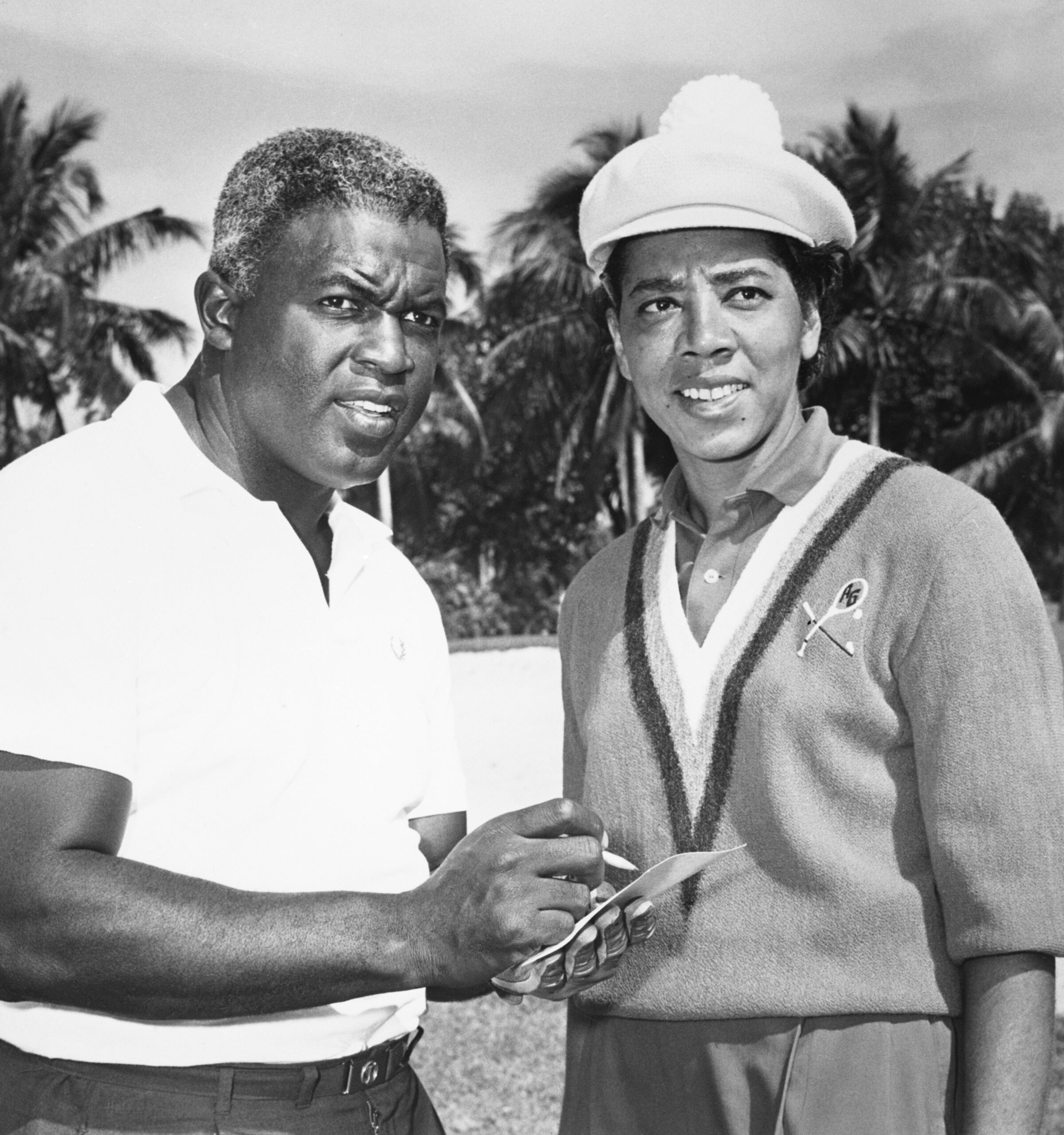
This picture, taken in February 1962 in Miami Springs, Florida, shows baseball legend Jackie Robinson and tennis star Althea Gibson sharing their mutual passion for a different sport: golf.
In 1947, Robinson joined the Brooklyn Dodgers, becoming the first Black man to play Major League Baseball in the 20th century. In 1950, Gibson became the first Black person to compete in what is now the U.S. Open, earning her the label “the Jackie Robinson of tennis.”
The picture was taken at Ray Mitchell’s North-South Winter Golf Tournament, an annual event that was sponsored by Black-owned businesses and that attracted Black celebrities. Gibson and Robinson won the women’s and men’s amateur titles, respectively.
The picture follows the gender norms of its era and contemporary perceptions of Robinson and Gibson: he is active, holding a pencil and a scorecard, while she, arms down, may be read as his comparatively passive subordinate. But the image also captures Gibson’s and Robinson’s contrasting yet no less meaningful approaches to diversifying American golf.
Golf, among the most class-conscious of sports, clung to segregation. Country clubs catalyzed the game’s growth for decades but they banned African Americans. Public courses were unwelcoming, too. Miami Springs Golf Course, where Gibson and Robinson pose, was one of many that African Americans had sued since the late 1940s to access.
The Professional Golfers’ Association of America, founded in 1916, maintained a “Caucasians only” policy as well. Codified in the PGA’s 1934 constitution, it barred African Americans from membership and from entering its tournaments.
The PGA’s Caucasian clause stood even after the National Football League (1946), Major League Baseball (1947), and the National Basketball Association (1950) desegregated. African Americans founded the United Golfers Association in 1925 to create competitive opportunities and was not segregated.
Robinson, a keen recreational player, had personally experienced racism in golf. A private club in Connecticut rejected his membership application in 1956, the year he retired from baseball.
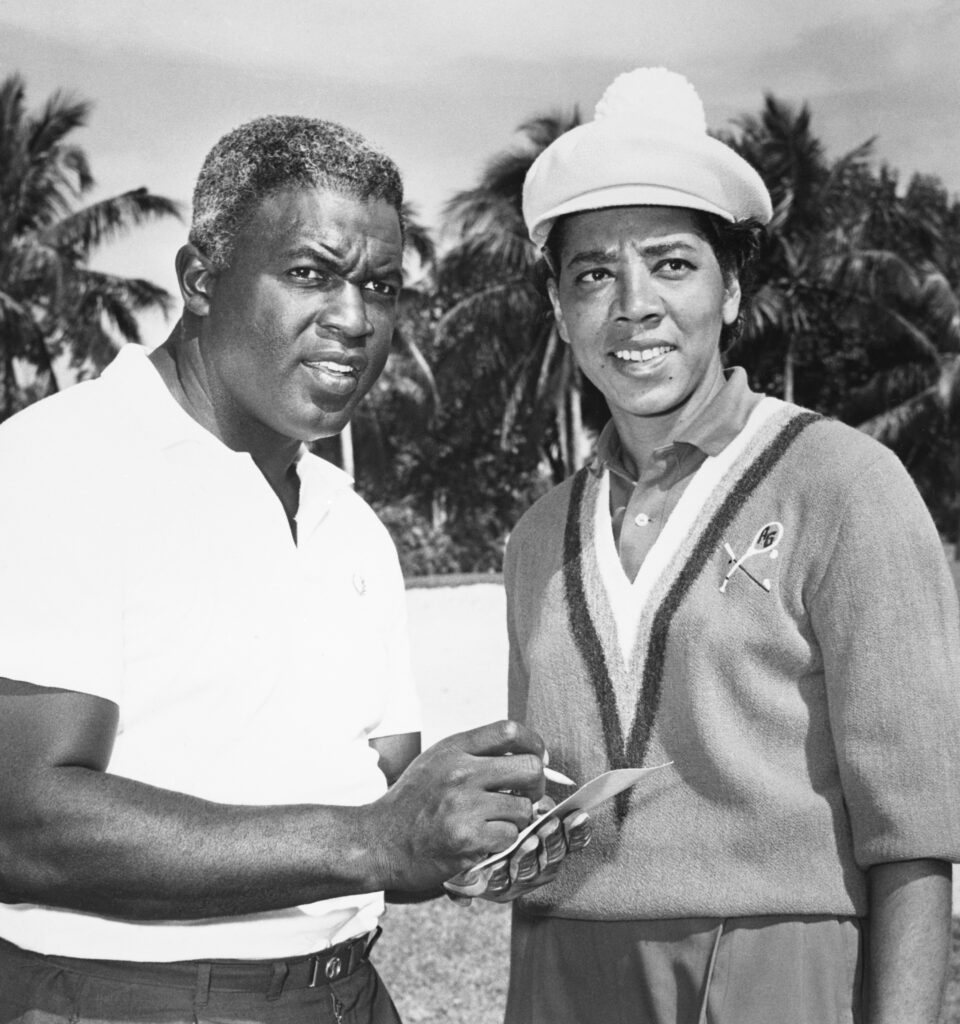
Photo by Bettmann Archive/Getty Images
In the picture, Robinson’s stance with the pencil is significant. Poised like a boxer, his hands evoke his leadership in fighting discrimination in the sport. Robinson started writing for the New York Post in 1959 and used his column to attack prejudice.
A lifelong firebrand for racial equality, he wrote columns that criticized prejudice in golf and excoriated the PGA for not allowing Charlie Sifford, six-time winner of the UGA’s National Negro Open, to enter tournaments.
The PGA approved Sifford for limited membership in 1960 and abolished the Caucasian clause in 1961. Legal threats, bad publicity, and global attention to segregation in America during the Cold War forced the change.
Simultaneously, Althea Gibson embarked on her golf career. She had reached the pinnacle of tennis by winning Roland-Garros (1956), Wimbledon (1957 and 1958), and the U.S. Open forerunner (1957 and 1958)—all firsts for Black tennis players.
Golf was a stimulating new challenge for her. It also brought the likelihood that operators of courses and tournaments would not allow her to compete, enter locker rooms, or use other parts of the clubhouse—all things she had endured in tennis.
Gibson faced the uncertainty gamely. In the picture, her arms are relaxed, reflecting her openness and self-described “faith” that she would be treated fairly.
At the height of Gibson’s tennis career, some members of the Black press had criticized her as silent on civil rights and useless in building pathways into elite tennis for Black men. To them, she was “the Jackie Robinson of tennis” only because of the many firsts that she had achieved—not because she was an activist like Robinson.
Gibson responded with nuance.
“There doesn’t seem to be much question that Jackie always saw his baseball success as a step forward for the Negro people, and he aggressively fought to make his ability pay off in social advances … I’m not insensitive to the great value to our people of what Jackie did. … But I have to do it [i.e. engage with social justice issues] my way. … I want my success to speak for itself as an advertisement for my race.”
That was Gibson’s spirit as she faced bigotry as the first Black player on the Ladies Professional Golf Association Tour, beginning in 1963.
Gibson’s sweater signals her individuality. Her initials are embroidered in the face of a tennis racket that overlaps a golf club. The monogram asserts Gibson’s identity as her own person in both sports.
Standing shoulder to shoulder as equals, Gibson and Robinson gazed forward in Florida. As part of the long history of spaces of leisure becoming sites of “race work” for African Americans, Gibson and Robinson shared a vision of golf as a game for everyone.
They simply had different ways of making their vision a reality.

Learn more:
Ashley Brown, Serving Herself: The Life and Times of Althea Gibson (New York: Oxford University Press, 2023).
Lane Demas, Game of Privilege: An African American History of Golf (Chapel Hill: University of North Carolina Press, 2017).
Charlie Sifford with James Gullo, “Just Let Me Play”: The Story of Charlie Sifford, The First Black PGA Golfer (Latham, NY: British American Publishing, 1992).
Arnold Rampersad, Jackie Robinson: A Biography (New York: Alfred A. Knopf, 1997).