

Photo by Bettmann Archive/Getty Images
Picture an advertisement with two young Black children, twins, holding hands or playing together in a home. They share the same joyful expression—with a touch of mischief—as they pour water on the kitchen floor.
One twin does the pouring while the other twin scrubs with brushes worn on the feet. They sport some white tutus over their coal-black skin, perfectly placed near the slogan, “Let the Twins Do Your Work.”
These cartoonish children, the wide-eyed “Goldie” and “Dustie” were used to mock Black people in American advertising, manufacturing, and entertainment.
The Gold Dust Twins joined other advertising campaigns, like Uncle Ben’s Rice, Cream of Wheat, and Aunt Jemima pancake mix that used racist portrayals to sell household products.
These cleaning agents were developed by the N.K. Fairbank Manufacturing Company—which was founded in 1864. The company’s original advertisements for its lard and soap featured young white women doing laundry in a wooden wash barrel.
Goldie and Dustie, first depicted simply bathing together in a washtub in 1892, replaced young white women as responsible for household chores. The implication was that white women could rest easy, while subservient Black children kept up the house. They drew on older conventions, like “Black Mammy” and “Uncle Tom,” that linked Black subordination with domestic work.
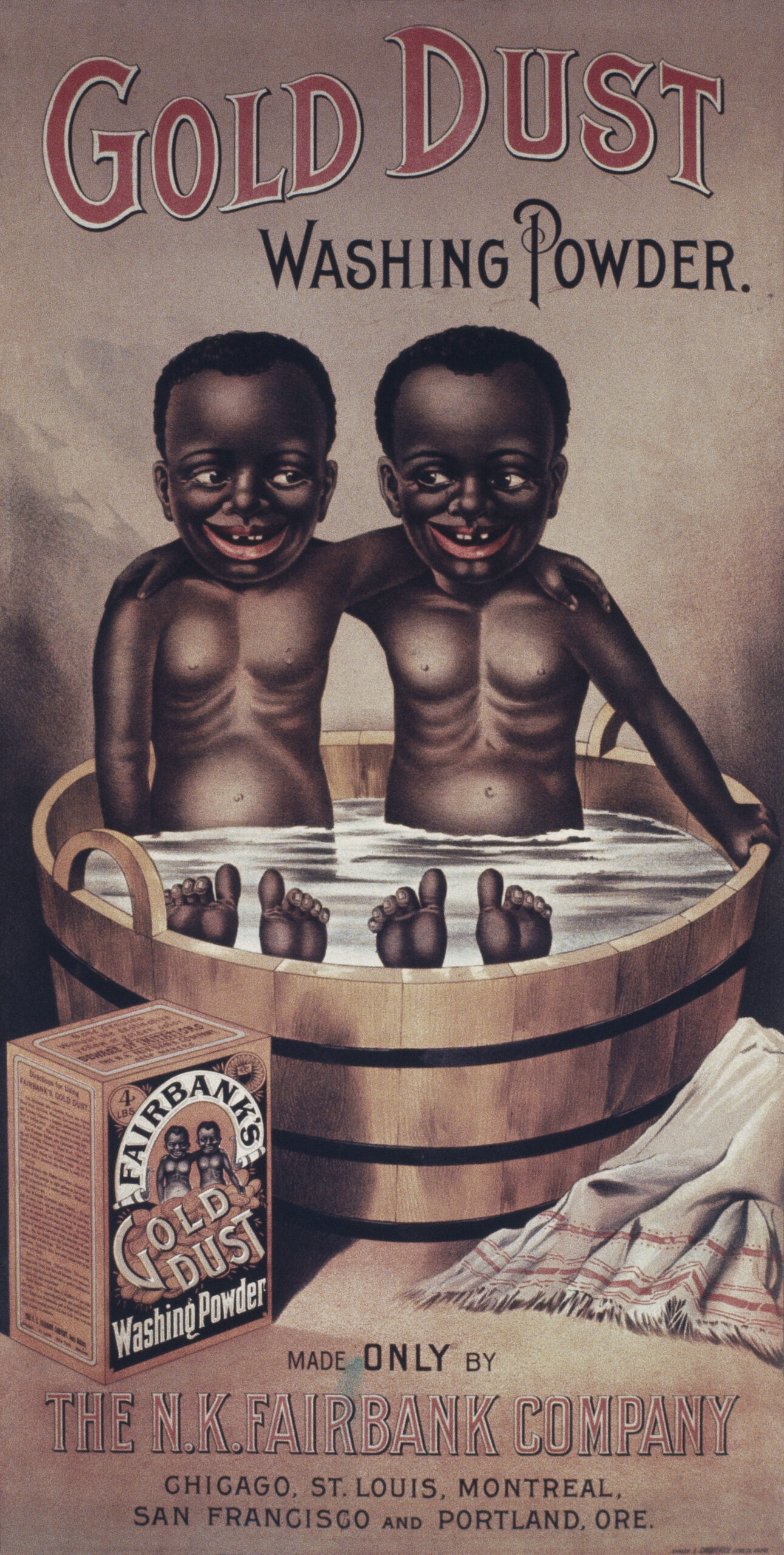
Photo by Bettmann Archive/Getty Images
The advertisements clearly worked.
A 1900 advertisement for the washing powder wrote: “[W]hen people think of oranges they think of Sunkist; when they think of Chesapeake they think of oysters and when the idea comes to their mind of getting their work done they think of The Gold Dust Twins—and they buy Gold Dust!”
The Twins and the product had become synonymous.
In this sense, the Gold Dust Twins helped reconfigure race relations after the end of slavery. Slavery had been eliminated, but the myth of the happy, simple, and docile Black worker lived on.
The Gold Dust Twins became fixtures of American popular culture in the first decades of the 20th century, until the campaign’s end around 1940.
Live actors, performing in blackface, portrayed Goldie and Dustie at the 1904 World’s Fair in St. Louis. In 1921, comedians Harvey Hindemayer and Earle Tuckerman, also in blackface, starred on the Gold Dust Twins radio show. The show stands as one of the first entertainment shows designed to promote a particular product.

Photo by Bettmann Archive/Getty Images
The signature tutus worn by the Twins were added after the original campaign was launched, and that leads us to question ideas about gender. We cannot be sure, but I suspect that the early renditions of Goldie and Dustie’s tutus—which resembled washing bubbles—were used to cover their male genitalia.
But over time, these tutus seem to be more consciously placed to characterize them as either asexual or demasculinized boys. In the context of gender norms of the era, this functioned to further demean Black masculinity.
Black people were mocked in American mainstream culture more broadly, and their presence in household products provided another stage on which they were ridiculed.
Attention to Goldie and Dustie’s personalities is equally important to their use in advertisements.
Like the “Sambo” character, the Gold Dust Twins are popularly portrayed as simple, docile, happy, and a bit mischievous, mixing an image of household cleaners and household rugrats. This personality type was paired with the reliability of the washing powder product. The combination argued for white families to be at ease while submissive, childlike Blacks worked at home.
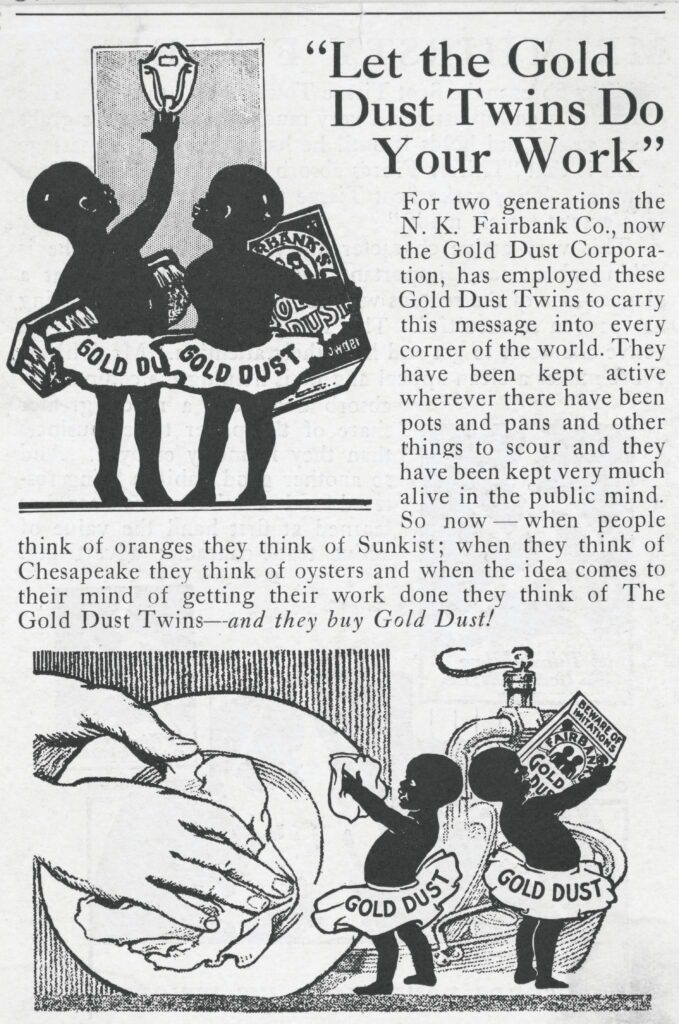
Photo by Bettmann Archive/Getty Images
Black imagery in American marketing campaigns, especially for household products, connected the ideas of a tidy home to a loyal Black caretaker. Goldie and Dustie’s cheerful personalities, and their portrayal as children, made the Gold Dust Twins campaign stand out among household products geared towards improving white American life. Goldie and Dustie showed that African Americans, from as early as childhood, were only meant for menial jobs.
“Gold Dust Twins” has been used more recently as a phrase to describe two individuals who pair up or cooperate successfully, especially in sports. That use strips the phrase of its racist roots and sanitizes it.
It allows us to forget that American advertisers commodified African American likenesses and perpetuated Black stereotypes in the early 20th century. And in the case of Goldie and Dustie, specifically, it was clear that Black children were not spared from these marketing campaigns.
March 2, 2026

Learn more:
Baker, Stacey Menzel, Carol M. Motley, and Geraldine R. Henderson. “From Despicable to Collectible: The Evolution of Collective Memories for and the Value of Black Advertising Memorabilia.” Journal of Advertising 33, no. 3 (2004): 37-50. https://www.jstor.org/stable/4189265
Kern-Foxworth, Marilyn. Aunt Jemima, Uncle Ben, and Rastus: Blacks in Advertising, Yesterday, Today, and Tomorrow. Greenwood Publishing Group, 1994.
Lemons, J. Stanley. “Black Stereotypes as Reflected in Popular Culture, 1880-1920.” American Quarterly 29, no 1 (1977): 102-116. https://www.jstor.org/stable/2712263
Manring, Maurice M. “Aunt Jemima Explained: The Old South, the Absent Mistress, and the Slave in a Box.” Southern Cultures 2, no. 1 (1995): 19-44. https://www.jstor.org/stable/26235388
Smith, Katharine Capshaw. “Childhood, the Body, and Race Performance: Early 20th-Century Etiquette Books for Black Children.” African American Review 40, no. 4: 795-811. https://www.jstor.org/stable/40033754