

Photo by Bettmann Archive/Getty Images
The black and white image above captures track and field athlete Wilma Rudolph breaking the tape after setting a new world record in the women’s 100-meter dash during the summer 1960 Olympic Games in Rome. With her head tossed back and spectators blurred, the photo tells an incredible story.
During the 1950s, white American women turned away from track and field. In postwar America, the ideal woman was supposed to focus on her domestic roles, and running, jumping, and throwing were considered unladylike, particularly for middle-class white women.
As a consequence, track and field created a pathway for Black women’s athletic participation at the collegiate and elite levels of competition. Specifically, historically Black colleges and universities (HBCUs) in the 1950s and 1960s provided opportunities for Black women to participate in the sport.
One such HBCU was Tennessee State University under the leadership of coach Ed Temple. The Tennessee State University Tigerbelles, as the women’s team was called, went on to produce an impressive cohort of champion track and field athletes, including Wilma Rudolph.
During the 1960 Rome Summer Olympic Games, Rudolph won gold in the women’s 100-meter dash, setting a new world record with a time of 11.3 seconds. During those same games Rudolph won a total of three gold medals, the first female American athlete to do so, cementing a place for Black women in the sport of track and field.

Photo by Bettmann Archive/Getty Images
Even more remarkable, all four members of the U.S. Women’s 4 x 100m relay team were veterans of Tennessee State’s track program (seen above (left to right): Wilma Rudolph, Lucinda Williams, Barbara Jones, and Martha Hudson). Together they set a world record for the event in a qualifying heat with a time of 44.5 seconds. They cruised to gold with a slightly slower time of 44.72.
Four years after Rudolph’s victory, another Tigerbelle, Wyomia Tyus claimed gold in Tokyo in the summer of 1964 (bursting across the line in the photo below). At the 1968 Mexico City Olympic Games, she did it again, becoming the first person to win consecutive Olympic gold medals in the 100-meter dash.
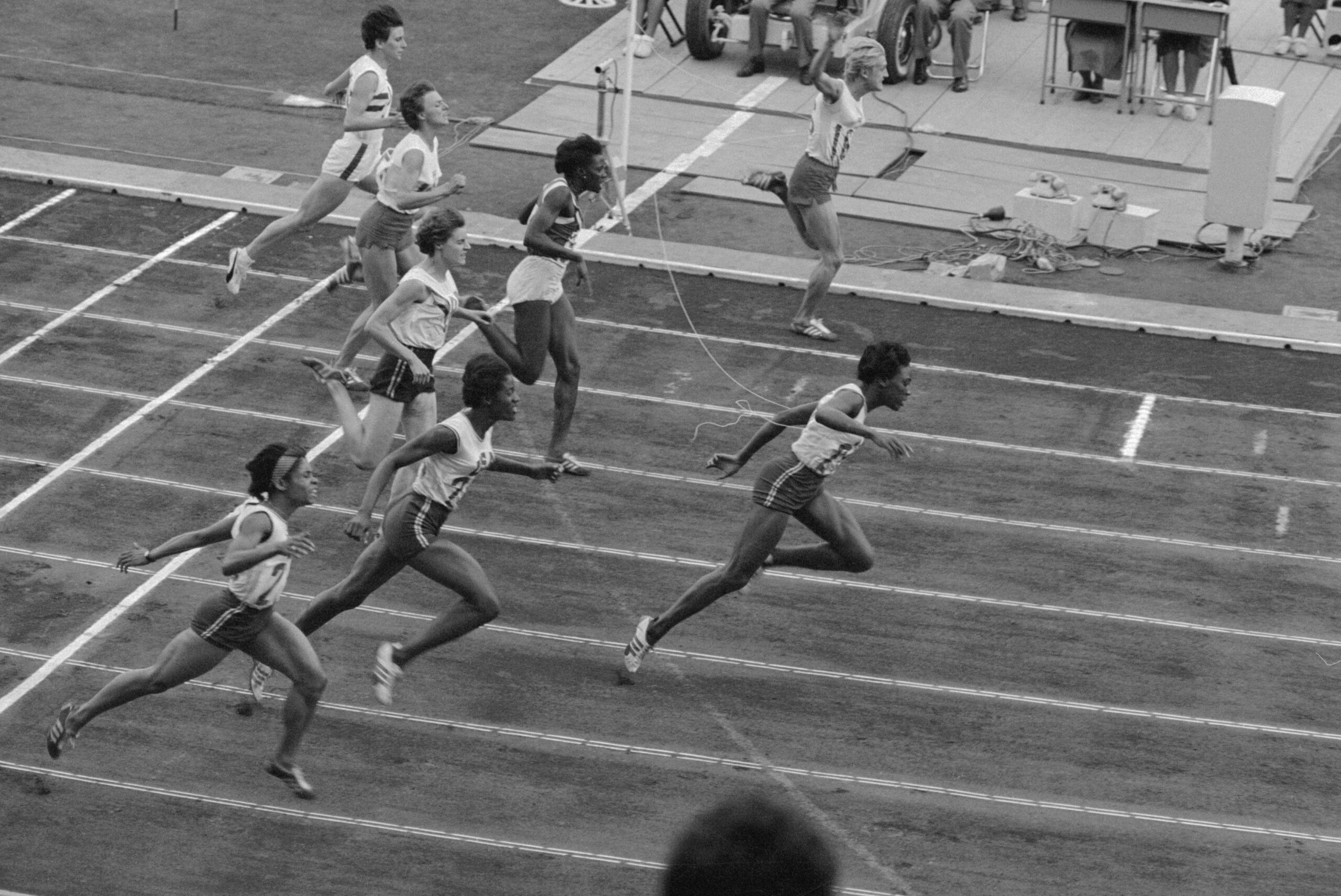
Photo by Bettmann Archive/Getty Images
Ed Temple’s Tigerbelles followed the path of Black high jumper Alice Coachman—the first Black woman from any nation to win a gold medal during the 1948 Summer Olympic Games in London (center on the podium below). Coachman met President Harry Truman when she returned in triumph after the Games and in 1952 became the first Black woman signed by Coca-Cola to be a spokesperson.

Photo by Bettman Archive/Getty Images
Individual athletes such as Coachman, Rudolph, and Tyus, as well as collectives like the Tigerbelles, created a space for Black women to reinvent and redefine what it means to be both Black and feminine.
The 1960 photo captures more than just one moment, it represents a new wave of Black sportswomen taking the sport of track and field by storm.
It is a representation of talent and grit that continues to be the example set by contemporary Black women in track and field.
January 7, 2026

Learn More:
Brown, L. E. C. (2025). Say Her Name: Centering Black Feminism and Black Women in Sport. New Brunswick: Rutgers University Press.
Collins, P. H. (2000). Black Feminist Thought: Knowledge, Consciousness, and the Politics of Empowerment. New York: Routledge.
Daley, A. (1960, Sept. 9). In praise of the Greeks. The New York Times, p. 20.
Gilreath, E. L., Zupin, D & Judge, L. W. (2017). “From field days to Olympic gold: How Black women revitalized track and field in the United States,” Physical Educator, 7(2), 359-76.
Tyus, W. and Terzakis, E. (2018). Tigerbelle: The Wyomia Tyus Story. Brooklyn: Edge of Sports.