

Photo by Bettmann Archive/Getty Images
Youth activism increased across the American South at the height of the Civil Rights Movement. But in years prior, young people were galvanized by the 1955 murder of 14-year-old Emmett Till from Chicago, who was lynched for allegedly whistling at a white store clerk in the Mississippi Delta.
These young activists saw themselves as the Emmett Till Generation.
The generation identified with Emmett because they were close in age to him, looked like him, and for those who lived in Mississippi, his murder was close to home. Till’s murder alerted the nation to the fact that children were not exempt from racial terror and violence.
Although Black children across the country could have been paralyzed by the terror of what had befallen young Emmett, many of them harnessed their fear, turning it into courage and action.
As civil rights activity escalated across the South, high school and college-aged students became resolute activists. By the early 1960s, Mississippi’s capital city, Jackson, was a hotbed of civil rights activity.
National Association for the Advancement of Colored People (NAACP) Youth Councils, mentored by the first full-time field secretary of the NAACP, Medgar Evers, mobilized the Black community to challenge segregation and discrimination in Jackson.
High school and college students canvassed neighborhoods, encouraging Blacks to vote, asking them not to buy from white-operated businesses along Capitol Street in downtown Jackson, and to boycott segregated events and public facilities. According to a Jackson youth group advisor, high school and college students were the “backbone” of mass marches and protest demonstrations in Jackson.
By the spring of 1963, children’s activism was commonplace in centers of movement across the South, while sustained media coverage seized the attention of the nation.
The lessons learned from the successful recruitment of youths in Jackson just a few years prior proved to be an effective strategy in the Birmingham movement. In early May, 1963, America watched as water hoses and police dogs were used to terrorize children demonstrating for equality in Birmingham, as captured in the photo below.
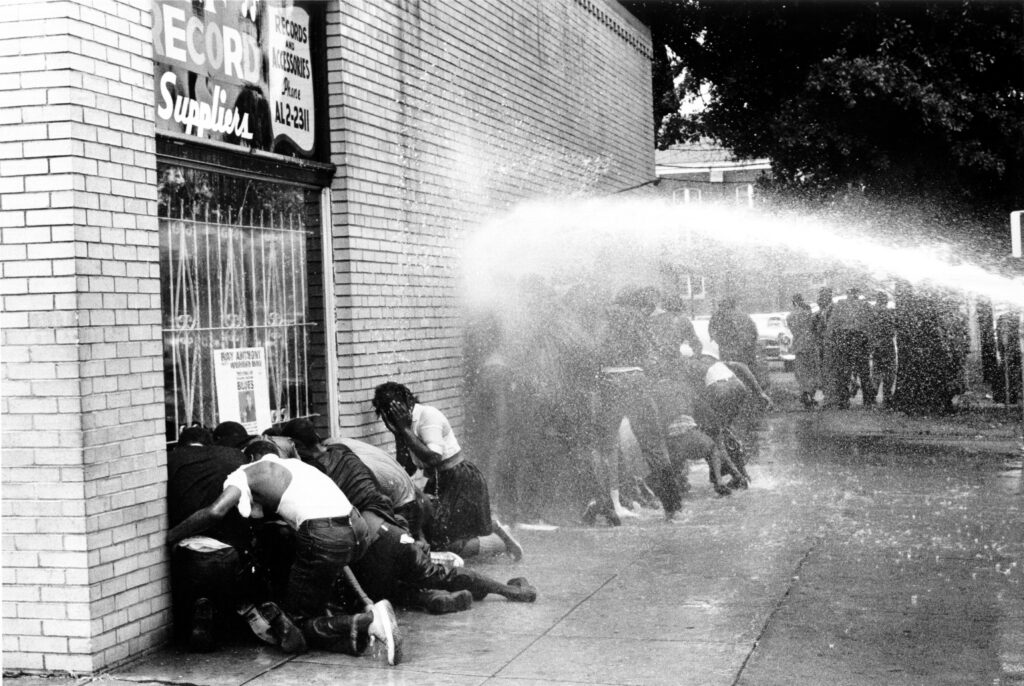
Photo by Michael Ochs Archives/Getty Images
Later that month, youth activists passionately demonstrated in downtown Jackson.
On May 28, students and a professor from Tougaloo College—a small, private institution on the north end of Jackson now known as the “Cradle of the Mississippi Civil Rights Movement”— sat in at the Woolworth’s lunch counter. This event, coupled with ongoing mass meetings and negotiations between civil rights leaders and city officials, set in motion weeks of demonstrations.
On May 30, students at Jackson’s William H. Lanier Jr./Sr. High School left the school’s building at noon to gather on the lawn and sing freedom songs, carrying American flags and banners as they sang, such as in the in the photograph below from June 17. Jackson police officers were dispatched, and dogs were brought to the high school.

Photo by Archive Photos/Getty Images
On May 31, young people between the ages of seven and eighteen gathered at Farish Street Baptist Church, located in the heart of Jackson’s Black community, to march to Capitol Street in downtown Jackson. Police officers, along with armed members of the Mississippi Highway Patrol, lined the street. Meanwhile, paddy wagons and city garbage trucks awaited the youth demonstrators to take them to jail.
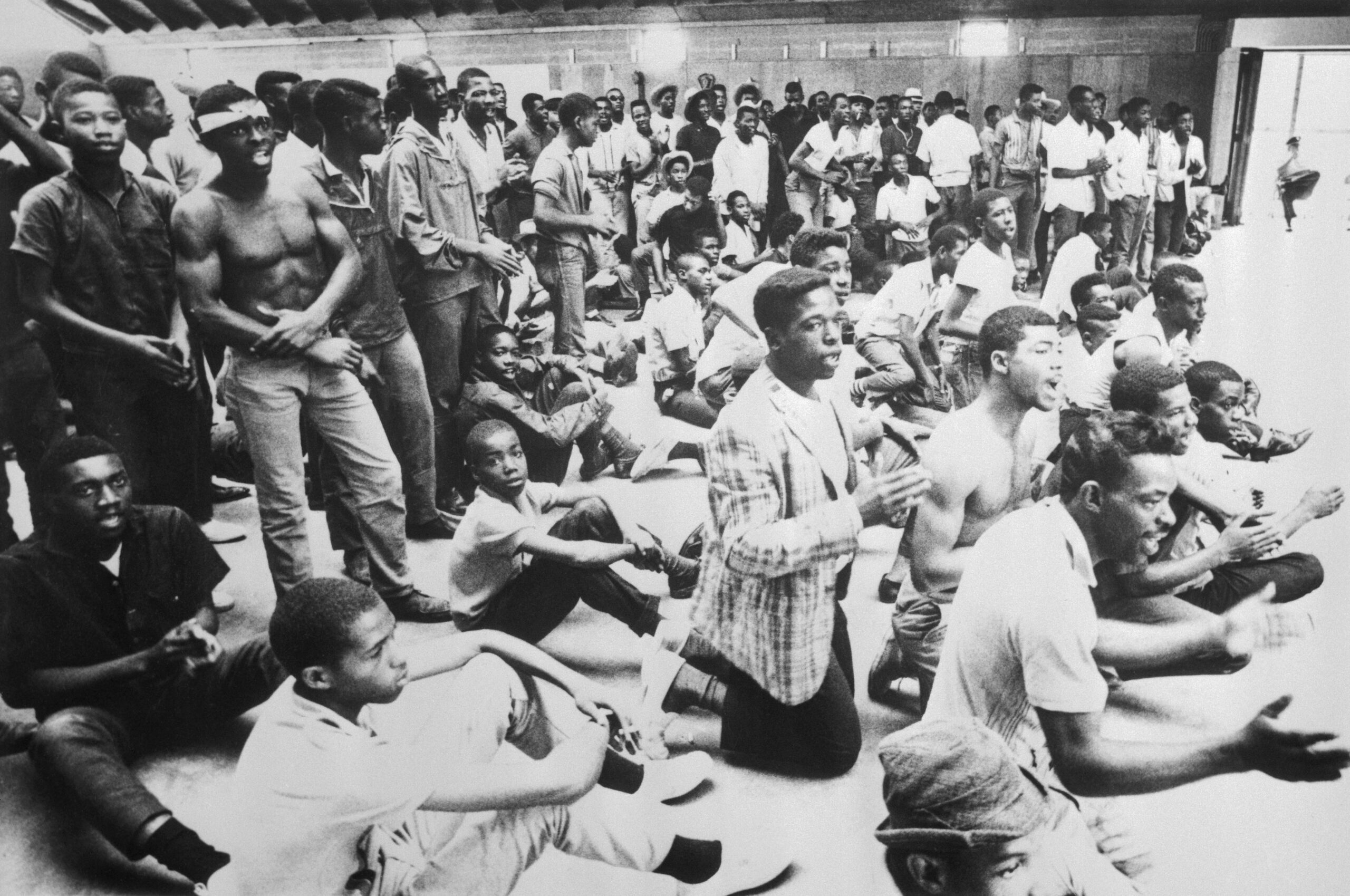
Because of the large number of children that were arrested, the Jackson Police Department was forced to convert the state fairgrounds’ livestock pens into a temporary jail, which many activists called a “concentration camp.” Jackson police officers referred to it as the “Fairgrounds Motel.” The 1965 image below illustrates the long use of the livestock pens as a makeshift jail from 1963 to then.

Photo by Bettmann Archive/Getty Images
Children under the age of eighteen were later released to their parents without a fine. Detainees over eighteen were fined $100. The police arrested a total of 421 demonstrators for parading without a permit. Between May 28 and June 5, there were 1,048 arrests.
On June 12, Medgar Evers was assassinated, and the civil rights community grew concerned that the movement was at its end. However, young people and their fervent commitment to freedom sustained the Jackson movement. After Evers’ funeral on June 15, mourners turned into demonstrators as they were led by young people marching towards downtown Jackson while singing “This Little Light of Mine.”

Photo by Archive Photos/Getty Images
Young people remained active after 1963. They proved to be effective in their actions, and Jackson city government began to concede to the demands of the local civil rights community. Change was on the horizon not just for Jackson, but for the South and the nation as a whole.
September 25, 2026

Learn more:
Chamberlain, Daphne Rochelle. “And a Child Shall Lead the Way: Children’s Participation in the Jackson, Mississippi, Black Freedom Struggle, 1946-1970.” PhD Dissertation. University of Mississippi, May 2009.
Dittmer, John. Local People: The Struggle for Civil Rights in Mississippi. Urbana, IL: University of Illinois Press, 1994.
Eskew, Glenn T. But for Birmingham: The Local and National Movements in the Civil Rights Movement. Chapel Hill: University of North Carolina Press, 1997.
Halberstam, David. The Children. New York: Random House Publishing Company, 1998.
Salter, John R. Jackson, Mississippi: An American Chronicle of Struggle and Schism. New York: Exposition Press, 1979.